Vajd’s project Zona has originated from the
artist’s critical and investigative attitude to people, from her
visual fascination in general, and from her pleasure in looking at images,
as if it were possible to discern in photographs what is indiscernible
in real life.
For Vajd, to photograph means to exist; she charts her existential experience
with her photographs, so much so that a manifestly personal, autobiographic
note permeates her entire oeuvre. This is perhaps least apparent in the
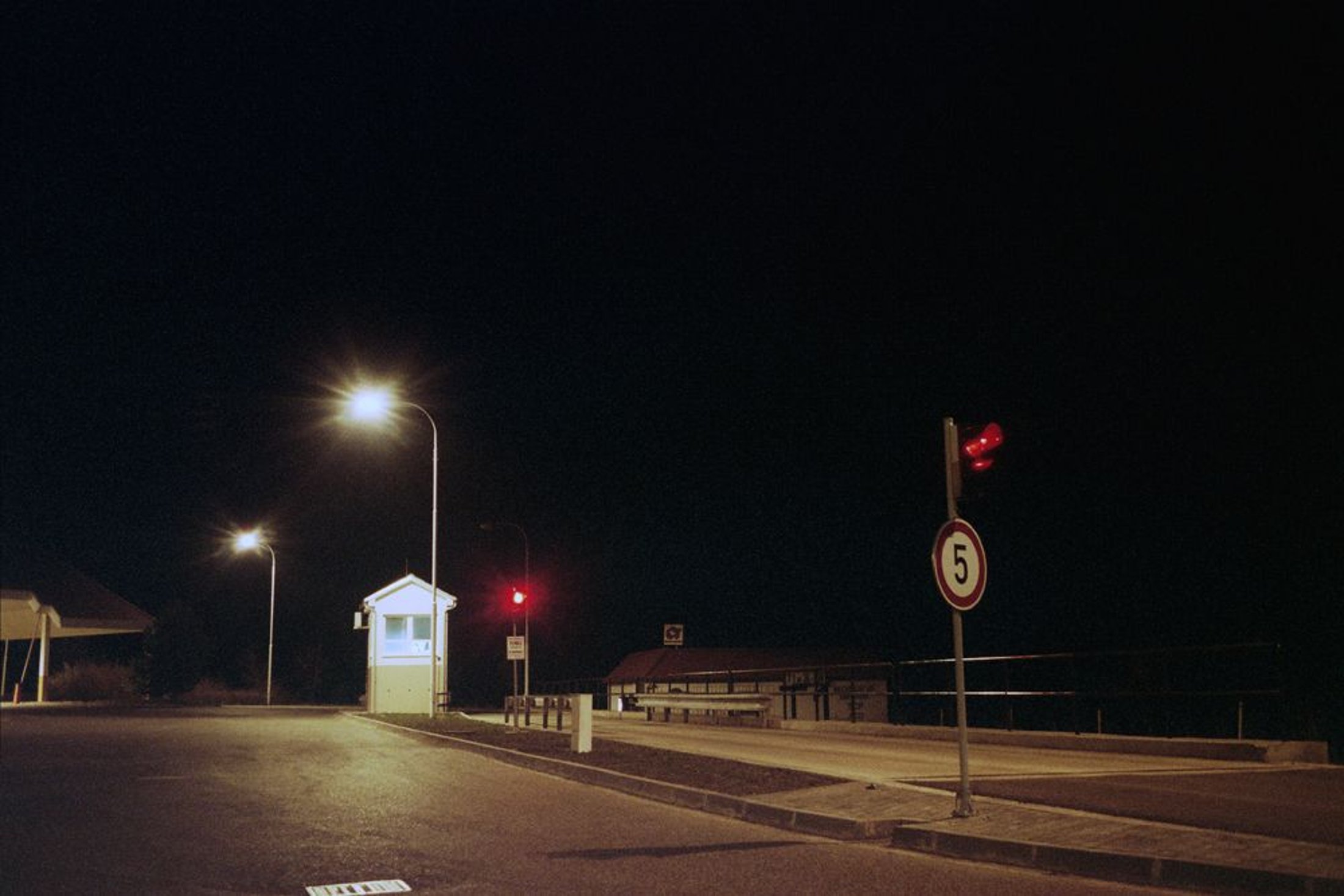
Zona project presented here: the photographs of the public areas of border
crossings refer to some general, not individual, reality.
Vajd’s fascination with these architecturally cold and grim places,
designed to exert control over people and, until the fall of the Schengen
border in 2007, used for inspecting travelers, does not stem from typological
research, but from psychological investigations. As a rule, the shots
contain no human figures, but are framed in such a way that the constellations
of various “furnishings” suggest a sinister atmosphere. The
suggested restricted freedom, confinement, control, and general submission
to certain social norms are associative rather than descriptive, becoming
more explicit in the few photographs in which the presence of uniformed
officials is discernible.
Psychologically, the photographs offer little chance of escaping from
the forbidding places, despite the fact that some of the shots were taken
after the places had ceased serving their original function. Without revealing
the identities of the places, the artist brings the images together in
a conceptual whole with a title that adds ambiguity rather than clarifies:
Zona. In Slovenian this can mean either “zone” or “shudder”.
On the one hand, the title identifies the content of the photographs,
which is meant to be pure denotation, while on the other hand it gives
the whole a specific connotation, whose significance the observers must
unravel themselves.
— Essay by Lara Strumej,
Head of the Photography Department,
Museum of Modern Art Ljubljana, Slovenia
Aleksandra Vajd was one of three photographers chosen to represent
Slovenia this year at the nightlong projection of photographs from 27
European countries at the Rencontres Festival in Arles. Lara Strumej served
as curator for the selections from Slovenia.

Feature
Zona
Aleksandra Vajd documents former border-control areas throughout the EU — architecturally cold and grim places, designed to exert control over people until the fall of the Schengen borders in 2007.
View Images
Feature
Zona
Aleksandra Vajd documents former border-control areas throughout the EU — architecturally cold and grim places, designed to exert control over people until the fall of the Schengen borders in 2007.
Zona
Aleksandra Vajd documents former border-control areas throughout the EU — architecturally cold and grim places, designed to exert control over people until the fall of the Schengen borders in 2007.
 © Farida Mahdy
 Critics’ Choice 2026

This photography competition is your opportunity to be recognized worldwide.
Top Awards include: An Exhibition in London, International Media Exposure, Cash Prizes, Solo Feature on LensCulture
Enter Awards
Deadline: April 22, 2026
