The specter of the Holocaust of the mid-20th century continues to haunt
generations of people throughout the world. The confusion, anger, horror
and emotions are perhaps strongest for the survivors of the camps and
for the families of those who did not survive.
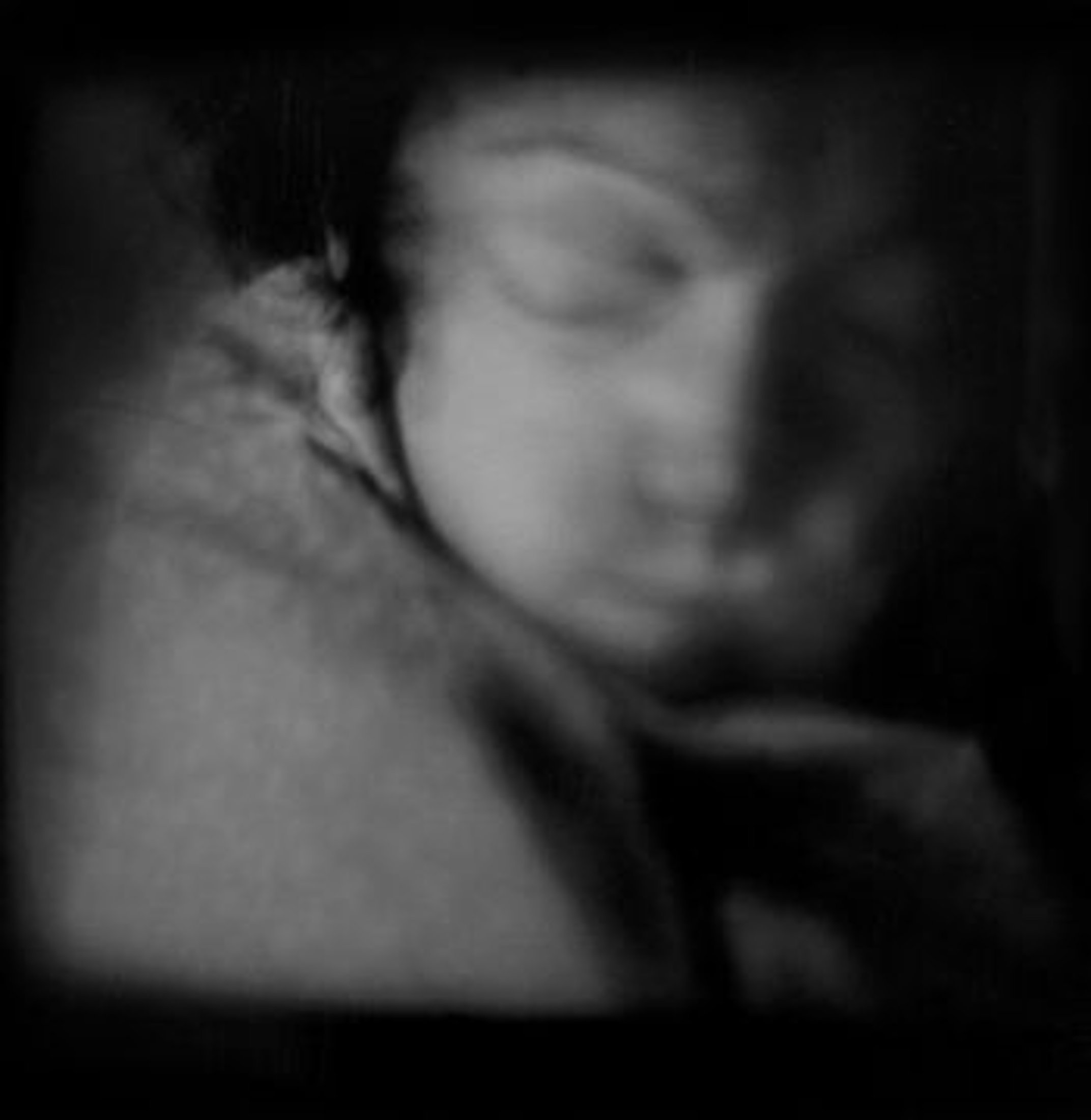
For several years now, Paris-based photographer, Isabelle Rozenbaum, has
been exploring her family’s personal history in connection with
the death camps. She lost many of her ancestors, and has been grappling
with that horrible fact, and trying to come to terms with it through photography.
She often had nightmares, dreaming about bones and bodies and blood and
more bones. So, she had an impulse several years ago to photograph her
face as she slept through the night, using a pinhole camera and an all-night-long
exposure. If she tossed and turned, the photo would be worthless; if she
moved very little, the resulting image would be remarkable. She made a
deliberate effort to put herself “into the camera”. She tried
this experiment off and on for almost three years, with ultimately great
success and surprisingly different results each time.
The range of emotions she captured in her night-long composite self-portraits
encouraged her to deepen her exploration, and to try to bring some of
the images of her nightmares into consciousness through her skills as
a photographer. This again prompted quite a bit of trial and error, ultimately
resulting in a collection of 51 photographs which are printed as small,
intimate square photos, and stacked in a box like a deck of cards.
It is an amazing experience to open this stack of photos at random, and
then to look at one card and then another. The dream-like connections
that arise, as you go from one to the next, are simultaneously bizarre
and understandable, horrifying and amusing. Certain images stick with
you, others surprise you after you have looked at them for a second or
third time. They are not simple images — they are rich, multi-layered,
disturbing, and definitely dreamlike.
The small format is seductively intimate, requiring that the viewer be
alone (as with a book), but in this case, holding each photograph, one
at a time, and engaging with each on a very personal level. The entire
collection can leave you mute, stunned, and quietly reflective for a long
time after "speaking" with them, one on one.
The series of photos is at once an attempt at exorcism, and a celebration
of the workings of an inquisitive human mind in sleep and wakefulness.
Based on the enthusiastic response this work generated, she was then encouraged
to further evolve the results of her personal inquiry into a 3-screen
projection video/sound installation piece, which premiered in Paris earlier
this Spring.
We are pleased to present here the 51 original still images.
— Jim Casper

Feature
être au monde (to be in the world)
Paris-based photographer Isabelle Rozenbaum uses her craft to try to
come to terms with her personal family history, the Holocaust, and the
insistent, visual murmurings of the unconscious.
View Images
Feature
être au monde (to be in the world)
Paris-based photographer Isabelle Rozenbaum uses her craft to try to
come to terms with her personal family history, the Holocaust, and the
insistent, visual murmurings of the unconscious.
être au monde (to be in the world)
Paris-based photographer Isabelle Rozenbaum uses her craft to try to
come to terms with her personal family history, the Holocaust, and the
insistent, visual murmurings of the unconscious.
 © Farida Mahdy
 Critics’ Choice 2026

This photography competition is your opportunity to be recognized worldwide.
Top Awards include: An Exhibition in London, International Media Exposure, Cash Prizes, Solo Feature on LensCulture
Enter Awards
Deadline: April 22, 2026
