Melt
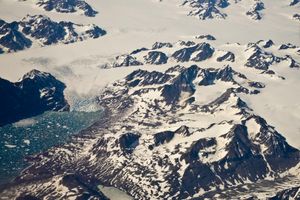
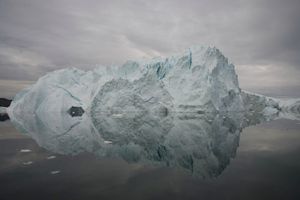
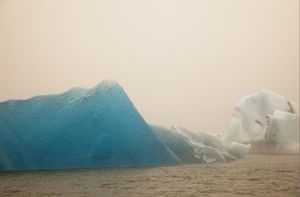
Icebergs and glaciers are the watery monuments of nature. Gina Glover’s exhibition Melt, a series of colour photographs of icebergs, glaciers and ice sheets shot in Greenland, Iceland and Spitzbergen, Arctic Circle, taken between 2009-2013, beautifully present to us these objects of natural sublime. Icebergs and glaciers, says Glover, provide more than an aesthetic existence; they provide a window into deep time. Some glaciers are hundreds of thousands of years old; trapped air bubbles reveal the chemistry of ancient atmospheres, providing a means of assessing climatic perturbations, past, present and future. The photographs of Icelandic icebergs are taken from Jökulsárlón Lake, at the foot of the Vatnajökull glacier. Here house-sized ice fragments break off from Vatnajökull and slowly drift across the lake, fragmenting into smaller and smaller pieces, eventually to disappear. The Greenlandic icebergs are photographed at the UNESCO heritage site at Disko Bay, near Ilulissat, some 300 km north of the Arctic Circle. The visual experience is akin to that of a continually reshaping landscape, like a vast chessboard of moving ice-pieces. The Nordenskjöld glacier, Spitsbergen, the Hvannadalshnúkur glacier, Iceland and the Eqip Sermia glacier, Greenland, present faces of solidity, dignity and power, but this belies their increasing vulnerability. Over the last century these glaciers have been in retreat, a phenomenon linked with increases in atmospheric CO2 and air, sea and land temperatures. These vast storehouses of fresh water are being released into sea at an increasing rate, raising the prospect of worldwide rising water levels. Some scientists predict that climate change may be approaching a "tipping point" resulting in a gradual, if inevitable, removal of the north polar ice sheet.
Photos (11)